DomCop Review 2026: Features, Pricing and Who It's For
Transparency first: some links on this site, including in this review, are sponsored DomCop links, and DomCop revenue supports this publication. That is precisely why this review is written the way it is: every claim below is checkable, the limitations get their own section, and the list of people who should not subscribe is real. If the economics do not fit you, we would rather you keep your money and our credibility.
What is DomCop?
DomCop is a research platform for expired domain buyers. It pulls expiring, expired, dropped and auction inventory from the major auction houses and drop streams into a single interface, then attaches third-party data to every row: Majestic Trust Flow, Citation Flow and Topical Trust Flow, Moz Domain Authority and Spam Score, referring domain counts, anchor text views and archived screenshots of what the domain used to be. The pitch is arithmetic. Somewhere between 100,000 listed and 200,000+ dropped domains move through the pipeline daily; nobody vets that by hand. DomCop's filters compress the firehose into a shortlist, and the attached evidence lets you disqualify most of the shortlist without opening ten tabs per name.
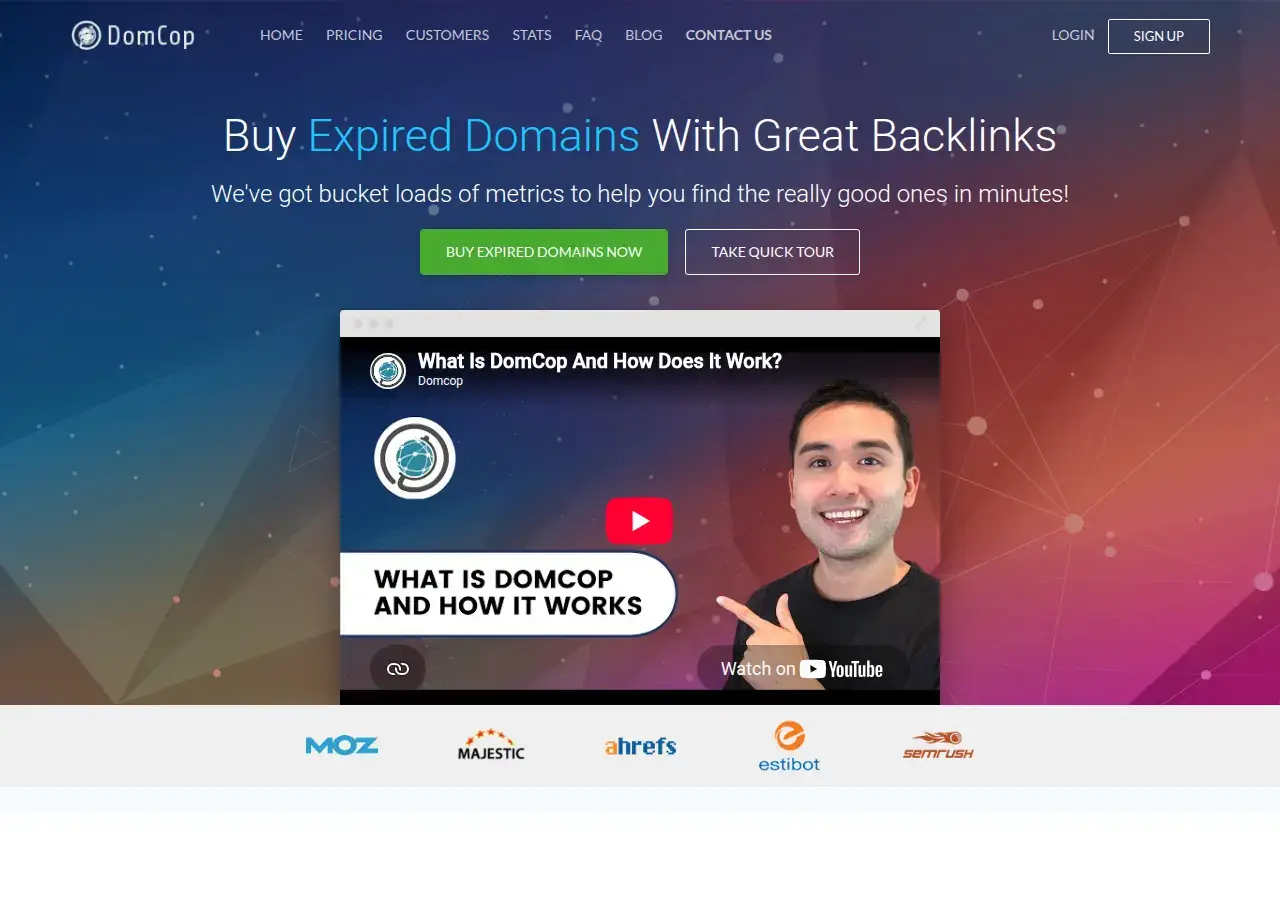
The DomCop homepage, naming the third-party data sources it attaches to listings, captured August 2026
The features that matter
- Aggregation: the major expiry auctions and drop lists in one screen, so research and bidding preparation stop being a multi-tab ritual.
- Metrics on every row: Majestic and Moz data side by side, which matters because authority tools disagree by about 26 points on average and a single-vendor view flatters bad domains.
- Archived screenshots and anchor text: the two fastest spam checks in the business, sitting inline. A domain whose screenshots show casino stretches or whose anchors read like a pharmacy disqualifies itself in seconds.
- Deep filtering: stack conditions like 50+ referring domains, healthy TF:CF ratio and clean spam scores, then save the search and work the survivors daily.
- Personal crawlers (Guru tiers): 10-50 crawlers that hunt expired domains in niches you define, for buyers who want inventory the shared lists undersell.
- Credits: a pay-as-you-go system for analyzing domain lists you upload, useful for vetting a portfolio or a scraped list against the same metric stack.
DomCop pricing in 2026
Pricing below is as of mid-2026; check the current DomCop pricing page before deciding, since plans shift occasionally.
| Plan element | What you get | Notes |
|---|---|---|
| Entry tier | Full aggregator: auctions, drops and expiring lists with Majestic and Moz metrics, screenshots and filters | From roughly $68/mo billed annually |
| Guru tiers | Everything above plus 10-50 personal niche crawlers and access to the archive of millions of already-dropped domains | Price scales with crawler count |
| Credits | Metric analysis of domain lists you upload | Pay as you go, separate from the subscription |
| Free trial | None | The refund window below is the effective test period |
| Refunds | 2-day money-back guarantee | Short; plan a hard test session for day one |
The honest limitations
Four things to price in before subscribing. The headline rate is an annual-billing figure, so the real commitment is a year of fees unless you accept costlier terms. The refund window is 2 days, which punishes anyone who subscribes during a busy week; treat activation day as test day or postpone subscribing. Credits for analyzing your own uploaded lists sit outside the subscription, so heavy list-vetting workflows cost more than the sticker price. And the personal niche crawlers, the feature that most differentiates the platform, live in the Guru tiers, meaning the entry tier buys aggregation and metrics rather than the full toolkit. None of these are dealbreakers for the target buyer; all of them matter to anyone at the margin.
Who is DomCop for?
The subscription pays for itself on volume. Agencies vetting domains for clients, portfolio builders working the auctions weekly, and SEO teams that treat expired domains as a standing acquisition channel all get the same return: hours. If you currently run ExpiredDomains.net plus three auction tabs plus a metrics tool, DomCop collapses that into one workflow, which is the honest core of the value and the reason it sits where it does in our 2026 tool rankings.
Who should not buy it
- Beginners buying a domain or two per quarter. The free stack, ExpiredDomains.net plus registrar closeouts, is genuinely enough while you learn; our free vs paid comparison shows exactly where the ceiling is.
- Pure spam-triage users on a budget. If your only need is junk filtering on bulk lists, SpamZilla at $37 per month does that one job cheaper, as our DomCop vs SpamZilla piece details.
- Anyone who needs a long trial. There is no free trial, and 2 days is a tight refund window. If you cannot schedule a proper evaluation session immediately after subscribing, wait until you can.
- .ai-only hunters. Expired .ai inventory lives in the official Namecheap dailies, not on general drop lists, so a general aggregator is not the main tool for that niche.
What about a free trial or a group buy?
Two questions people search before subscribing deserve straight answers. Free trial: there is none, and there was none as of mid-2026. The 2-day money-back guarantee is the sanctioned way to test, so subscribe when you have a free evening, run your real workflow hard, and decide inside the window. Group buys: resellers offer shared DomCop access at a fraction of the price. Beyond violating the terms such services are sold against, shared accounts gut the features that make the tool worth having: saved searches, personal crawlers and credits all assume one owner, and group-buy access has a habit of vanishing without refund. If the entry tier is out of budget, the free stack is the honest alternative, not a shared login.
Verdict
DomCop earns its fee for one specific buyer: the person who processes expired domain inventory regularly and values evidence density per minute. It is not cheap, its refund window is short, and casual buyers genuinely do not need it. But as of mid-2026 nothing else merges auction aggregation, dual-vendor metrics, screenshots and anchor data this completely, and for weekly buyers the hours saved outrun the invoice. If that describes you, test it properly inside the guarantee window and let your own shortlist decide.
Frequently asked questions
Does DomCop have a free trial?
No. DomCop has never offered one as of mid-2026. The 2-day money-back guarantee is the effective trial: subscribe, test your real workflow immediately, and refund inside the window if it does not fit.
How much does DomCop cost?
Annual plans start around $68 per month for the entry tier, with Guru tiers scaling up as they add 10-50 personal crawlers and archive access. Credits for analyzing your own lists are billed separately. Prices drift, so verify on the pricing page.
Is DomCop worth it compared with free tools?
For frequent buyers, usually yes: the aggregation and per-row evidence replace hours of tab-juggling per week. For occasional buyers, usually no: ExpiredDomains.net and the registrar streams cover learning and light hunting for free.
Are DomCop group buys safe?
No. Shared accounts violate the terms they are resold against, the personal features (saved searches, crawlers, credits) collapse when strangers share them, and access can disappear overnight with no refund path. Use the free stack instead if budget is the constraint.
Sources
- DomCop: pricing guide
- DomCop: buying expired domains guide
- DomCop: anchor text analysis
- ExpiredDomains.net (the free baseline)
- SpamZilla (the budget comparison point)