DomCop vs ExpiredDomains.net: Free vs Paid Research Compared
This is the matchup everyone in expired domain research eventually faces: the free database that has served the community for years against the paid aggregator that promises to do the tedious parts for you. Both are good at what they were built for, and what they were built for is not the same thing. Both have also outlived nearly every competitor from the 2010s, which tells you the free and the paid model both work; the question is which one works for you. Here is the honest head-to-head, current as of mid-2026.
What each tool actually is
ExpiredDomains.net is the long-running free reference database. It tracks deleted, expiring and auction-listed names across 676 TLDs, refreshes daily, and hands you sortable lists with basic counts and columns. A free registration unlocks the more useful filters. There is no bill and no lock-in, which is exactly why almost everyone in this niche started there.
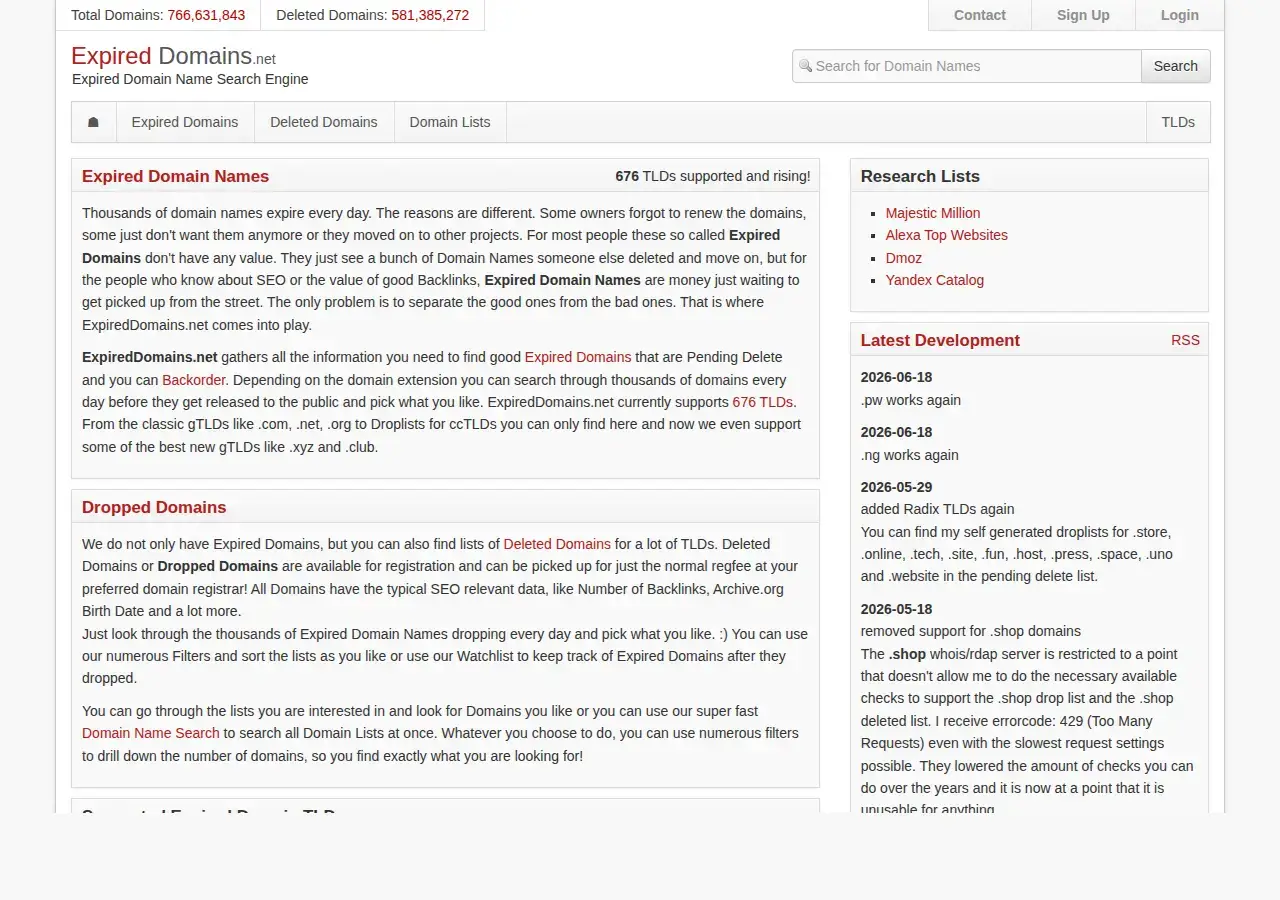
The ExpiredDomains.net homepage with its database counters and research list navigation, captured August 2026
DomCop is a paid aggregator. It pulls expiring, expired, dropped and auction domains from the major auction houses into one interface and attaches third-party metrics to every row: Majestic Trust Flow, Citation Flow and Topical Trust Flow, Moz Domain Authority and Spam Score, and more, plus archived screenshots for history checks. Annual plans start at roughly $68 per month at the entry tier and rise to Guru tiers that include 10 to 50 personal crawlers; a credits system covers analyzing lists you upload yourself. There is no free trial, but there is a 2-day money-back guarantee.
Feature by feature
| Feature | ExpiredDomains.net | DomCop |
|---|---|---|
| Price | Free; registration unlocks filters | From roughly $68/mo billed annually; no free trial, 2-day money-back guarantee |
| TLD coverage | 676 TLDs, the widest free net | Major TLDs plus the big auction house streams |
| SEO metrics | Basic counts and simple columns | Majestic TF, CF and Topical TF, Moz DA and Spam Score, referring domain data and more per row |
| Auction coverage | Lists auction inventory in separate views | Aggregates auctions, closeouts and drops into one filterable screen |
| History vetting | Manual; you open Wayback and check yourself | Archived screenshots and spam-related metrics built into the listing |
| Filtering | Solid column filters once registered | Deep stacked filters designed for shortlist building at volume |
| Your own lists | Not supported | Credits system analyzes uploaded lists |
| Best for | Learning the market and casual hunting | Frequent buyers who price their own hours |
The same search, side by side (illustrative)
Suppose you want a gardening domain with real links for a rebuild. On ExpiredDomains.net you filter the deleted-domains list by keyword and backlink count, export a few dozen candidates, then open each one in a metrics tool and the Wayback Machine, checking Trust Flow, spam signals and history by hand. Budget an evening. On DomCop you stack the same requirements as filters, ask for, say, 30+ referring domains with a TF:CF ratio above 0.3, sort by Topical Trust Flow in the gardening category, and open archived screenshots without leaving the row. The shortlist appears in minutes. The two tools reach the same finalists; what you buy is the distance between an evening and a coffee break.
Where ExpiredDomains.net wins
Price, breadth and zero commitment. Free access to 676 TLDs is an extraordinary amount of market visibility for nothing, and for ccTLD hunting outside the mainstream, its coverage is often the only practical option. It is also the better learning environment: nothing teaches you what a normal drop day looks like faster than scrolling one. The honest caveats: metrics are thin, so every candidate still needs manual vetting elsewhere, and the crowd problem is real, since every obviously good name on a free public list gets seen by thousands of hunters the same day. It also carries auction and marketplace views alongside the deleted lists, so you can follow a name from expiring to dropped without paying anyone.
Where DomCop wins
Time per qualified domain. The workflow difference is structural: on the free side you export candidates and check metrics tool by tool; on DomCop the metrics, screenshots and auction data are already on the row, so you filter down to a shortlist in one pass, for example 50+ referring domains with a healthy TF:CF ratio and a clean history. Add the archive of millions of already-dropped names and the credits system for your own lists, and the paid fee buys consolidation more than secrets. The honest caveats: roughly $68 per month is real money for a hobbyist, and nothing DomCop shows is unobtainable manually if your time is free. The archive matters more than it sounds, though: when a niche idea arrives late, searching millions of already-dropped names beats waiting weeks for fresh drops to match it.
What does DomCop actually cost?
Entry pricing is roughly $68 per month billed annually, and higher Guru tiers add 10 to 50 personal crawlers for niche-specific hunting plus larger credit allowances for analyzing your own uploaded lists. Two policies to know before paying: there is no free trial, and the 2-day money-back guarantee is the only test window, so plan your evaluation searches before you subscribe. Against that, ExpiredDomains.net costs exactly nothing forever, which is why this comparison is really about the price of your research hours rather than the price of software.
Which should you choose?
Honest rules of thumb, assuming the goal is buying domains well rather than owning software:
- Just starting out: ExpiredDomains.net, no question. Learn the lifecycle on the free tier first; our expired domain primer pairs well with it.
- Buying one domain for one project: stay free, vet manually, and spend the savings on the domain itself, or on outbidding someone at the auction.
- Buying monthly, or billing clients: DomCop; the hours saved on vetting typically outweigh the fee at even a few purchases a month.
- Most realistic setup: both. Plenty of buyers discover on ExpiredDomains.net out of habit and qualify candidates in DomCop, and the two tools do not fight each other.
Frequently asked questions
Is ExpiredDomains.net completely free?
Yes. Browsing is free and registering an account, also free, unlocks the better filters and columns. Its business runs on ads and marketplace links rather than subscriptions.
Is DomCop worth it for a single purchase?
Usually not. It is built for repeat research, and its pricing reflects that. If you want to test it on a real shortlist anyway, the 2-day money-back guarantee is the effective trial window, since there is no free tier.
Can I use both together?
Yes, and many buyers do exactly that: broad discovery across 676 TLDs on the free database, then metric-level qualification, screenshots and auction tracking on DomCop before bidding.
Does DomCop replace a backlink tool subscription?
For expired domain research, largely yes: Majestic and Moz numbers arrive attached to every listing, which is the data most vetting decisions need. For deep link audits of a domain you already own, dedicated backlink tools still go further.
Do these tools cover expired .ai domains?
The official expired .ai stream runs through daily Namecheap auctions, since .ai names never publicly drop. Whatever tool you use, confirm its TLD and auction coverage matches the names you hunt; see our full tool comparison for the specialist options.
Sources
- ExpiredDomains.net (coverage and free registration)
- DomCop pricing guide
- DomCop: buying expired domains guide
- DomainDetails: expired domain auctions compared