How Many Domains Expire Every Day? Expired Domain Statistics 2026
Ask how many domains expire per day and you will find published answers of 35,000, 100,000, 200,000 and 300,000, all from credible sources. None of them are wrong. They count different stages of the same conveyor belt, and understanding which stage each number measures is the entire trick to reading expired domain statistics. All figures below are current as of mid-2026.
The daily numbers, reconciled
| Figure | Number | What it actually counts |
|---|---|---|
| Listed as expiring or expired | ~100,000 per day | Names appearing on public expiry lists and auction feeds, still inside grace or auction windows |
| Dropped or deleted | ~200,000+ per day | Names completing deletion across all TLDs and returning to the public pool |
| GoDaddy Auctions intake | 35,000+ per day | New expiring domains entering a single registrar's auction stream |
| SpamZilla processing | ~300,000 per day | Expired domains one tool ingests for spam scoring, including multiple lifecycle stages |
| ExpiredDomains.net coverage | 676 TLDs | Breadth of the largest free database tracking deleted and expiring names |
| DomCop archive | Millions of domains | Already-dropped names kept searchable with metrics in the paid aggregator's archive |
Why do the numbers disagree?
Because "expire" is not one event. A single .com that misses renewal can be counted three separate times over its roughly 65-80 day journey: once when it appears on expiring lists during the registrar grace period, once when it hits an expiry auction, and once more when it finally deletes and drops. Lists also differ in TLD coverage: a tracker watching .com and the major gTLDs sees a different world from one polling 676 TLDs. And auction streams only cover names their registrar controls, which is why GoDaddy's 35,000+ daily intake is a subset of the 100,000-plus names listed market-wide. When you see two conflicting daily figures, the first question is always: listed, auctioned, or deleted?
A second subtlety: lists deduplicate differently. A name listed at auction on Monday can reappear as a closeout on Friday and again as pending delete three weeks later, and some trackers count every appearance while others count the name once. Neither approach is wrong; they just answer different questions.
The supply side: how many domains exist at all
Daily expiry volume is a percentage game played on an enormous base. Verisign's Domain Name Industry Brief for Q4 2025 puts total registrations at 386.9 million domains, up 6.2% year over year, with .com at 161.0 million, ccTLDs at 145.6 million and new gTLDs at 47.8 million (up a striking 29.9%). The arithmetic explains the drop counts: every single percentage point of that base that lapses in a year is about 3.9 million domains, or roughly 10,600 per day. It only takes a small minority of owners walking away to keep six figures of names moving through the expiry pipeline daily. The composition is shifting too: new gTLDs grew nearly five times faster than the overall market, and trend-driven registrations churn back into the expiry stream faster than established .com portfolios ever did.
Where do all these domains go?
Most expired names die unwanted and get hand-registered later or not at all. The contested minority moves through three channels: expiry auctions during the grace window (wins keep the original registration date), backorders and drop catching at deletion (DropCatch holds 1,200+ registrar accreditations for the race, and even top catchers land an estimated 30-50% of contested names), and plain hand registration after the drop, where .com and .net names release daily starting around 2:00 pm US Eastern.
The exception worth knowing: expired .ai domains never publicly drop. Since February 2025 they sell through official daily Namecheap auctions, with unsold names entering the registry DropZone. The TLD grew from about 40,000 registrations in 2020 to roughly 859,000 by August 2025, was adding about 2,008 new registrations per day as of January 2026, and single months have topped $600,000 in expired .ai sales.
When do domains actually drop?
.com and .net deletions release in one daily batch starting around 2:00 pm US Eastern, which is why serious drop catching is measured in milliseconds and why DropCatch maintains those 1,200+ registrar connections. Other registries run their own clocks: .de names can delete almost immediately once requested, .uk names sit suspended for roughly 90 days under Nominet's rate-limited, equal-chance polling system, and .ai never free-drops at all. If you follow daily expiry statistics in order to buy rather than out of curiosity, the release schedule matters as much as the volume, because the interesting slice of each day's inventory is spoken for within seconds.
From drops to dollars: the sales layer
Only a thin slice of expiring inventory ever resells, but that slice is growing. NameBio recorded roughly 190,300 domain sales worth over $244 million in 2025, up 31.9% year over year, with the first half alone at $122 million (up 42.7%) and ccTLD sales up 61%. NameBio itself estimates it captures only 5-10% of the retail market, so the true aftermarket is several times larger. The headline grabbers sit far above the daily churn: reported sales include Chat.com at $15.5 million to OpenAI in 2024 and AI.com at roughly $70 million in April 2025, but those are outliers, not the market. Meanwhile the industry consensus for portfolio sell-through sits around 1-2% per year, which is why volume statistics and profit statistics tell such different stories. For what these numbers mean when picking a name, see our guides to what an expired domain is and whether expired domains still work for SEO.
How to watch the daily flow yourself
ExpiredDomains.net remains the free reference point, covering deleted and expiring names across its 676 TLDs with daily updates. The registrar streams at GoDaddy, Dynadot and Namecheap show the auction-side flow directly. Aggregators charge for consolidation: DomCop merges the major auction houses and drop lists into one filterable screen with metrics attached, and keeps an archive of millions of already-dropped names, from roughly $68 per month billed annually. Our tool comparison covers the full field.
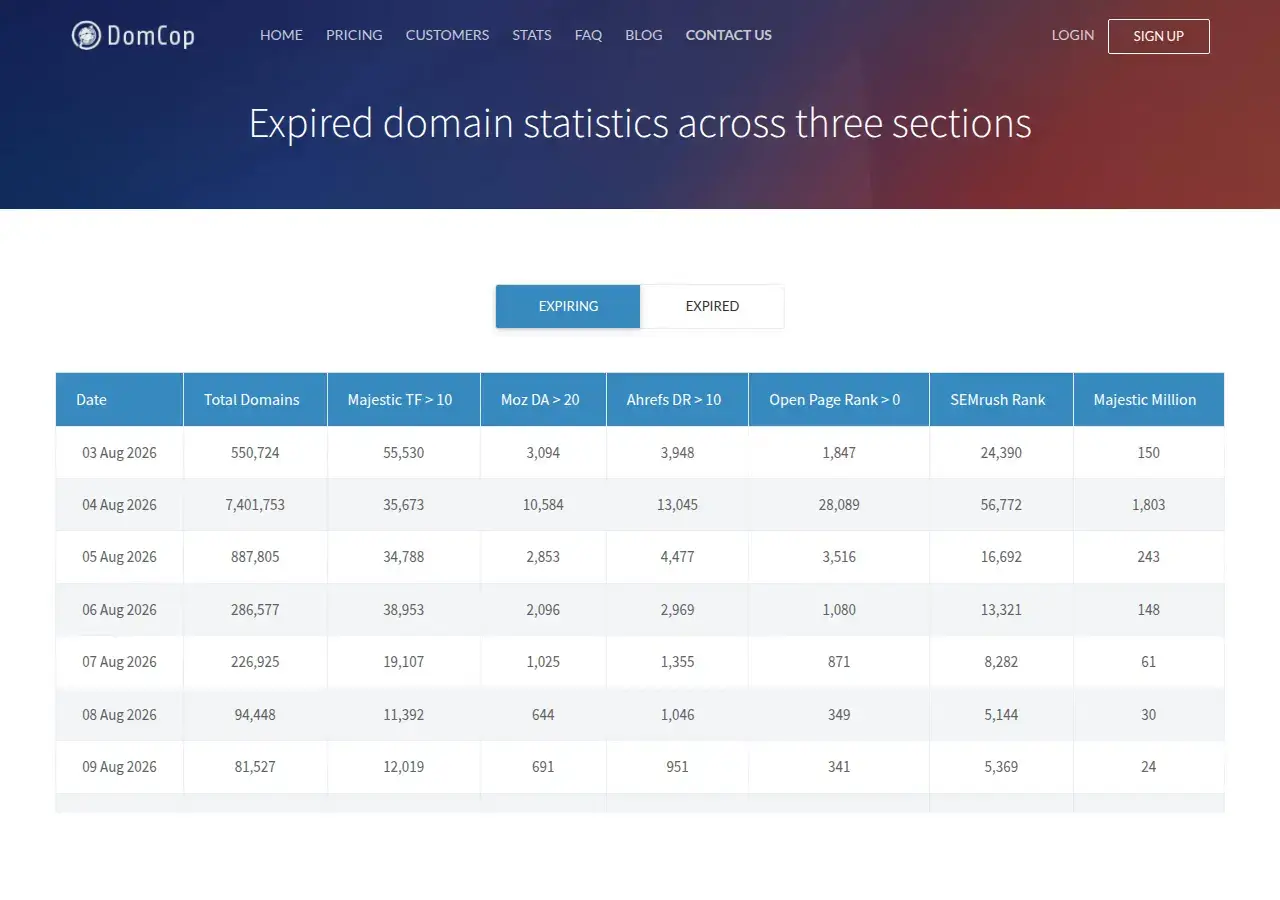
The public DomCop statistics page lists expiring-domain counts for each day with the metric columns attached, captured August 2026
Frequently asked questions
How many domains drop at 2:00 pm Eastern?
Verisign releases deleting .com and .net names in one daily batch starting around 2:00 pm US Eastern, and the batch size varies day to day. Across all TLDs and registries combined, public trackers put daily deletions at roughly 200,000 or more.
Do more domains expire than get registered?
No. The total base grew 6.2% year over year to 386.9 million in Q4 2025, so new and renewed registrations outpace deletions. Expiry is churn inside a growing market, not evidence of a shrinking one.
Which TLD has the most daily expirations?
.com, simply because it is the largest zone at 161.0 million registrations. Proportionally, fast-growing speculative TLDs can churn harder, since names registered on trends are renewed less reliably than established brands.
What share of dropping domains get caught?
No registry publishes a catch rate, but the competitive signal is clear: even the top drop-catching services succeed on an estimated 30-50% of contested names. The overwhelming majority of daily deletions attract no backorders at all and simply return to the open pool.
How current are these statistics?
All figures are as of mid-2026: registration totals come from Verisign's Q4 2025 industry brief, sales data from NameBio's 2025 reporting, and daily-volume figures from the platforms that publish them. Expect the registration and sales numbers to shift each quarter; the daily expiry magnitudes move more slowly.